
Another Point on the Compass

Updated: May 20
It's funny. Even the internet doesn't know how many books Wendell Berry has written. "More than 80" is the best it can do. Because of re-issues, early chapbooks, collaborative projects and repackaged editions, the total count is as unclassifiable as the man himself. But it's a lot.
So much in fact, that new or casual readers may find it difficult to digest what he's all about.
Being neither, I'm happy to share one key to reading Wendell. It's about the words.
Not all the words. Certain words. Certain words are portals to the large rooms of his mind. There are words he continually falls back on. They tend to show up in his book titles. They mean far more than we think they mean.
"Imagination." "Affection." "Particularity." "Possibility." "Enough."
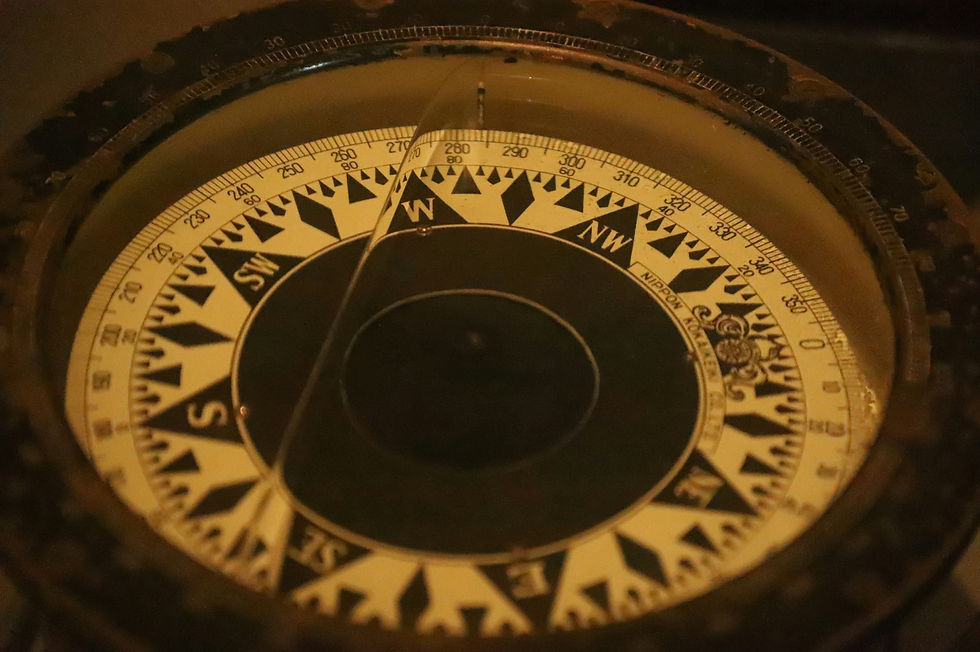
Having read so much Wendell over the years, I've learned to see the tracings and retracings of his thinking through this collection of words, noticing how they recur in his essays like a palimpsest. His writing covers a lot of ground -- these key words are the points of the compass. They make sense of all that territory.
To be more straightforward about it, they are his themes.
I've learned to be on alert then, when reading him. You have to proceed slowly, rereading passages or even whole essays to recognize when you've entered one of these spacious and brightly lit rooms.
Like in "Looking Ahead" (1978), another short, prescient and critical tract from The Gift of Good Land. It is remarkable in several regards.
It begins with Wendell commenting, critically, that "futurology" has apparently become a trade. By 1978, a new class of consultants and academics were being paid handsomely to predict the future either because there weren't enough jobs for PhD's, or because corporations needed academic endorsements, or because it's just a great job, since the future is an unfalsifiable place where no one can ever be provably wrong, Wendell, grouchy about it and always partial to horse-sense, quotes his neighbor: "That ain't what I'd call a job. That's what I'd call a position."
He begins by trashing this new (or newly noticed) university-based preoccupation with forecasting/fortune-telling despite the "fundamental truth that we can never be sure what will happen in the next minute much less in the next century." Then he summarizes the predictions of eleven Purdue engineering professors on what life would be like at the beginning of the 21st century.
Here's one crazy thing about this essay: Wendell's premise is that futurology is a fool's errand. But slap my face and call me Sally if these eleven dudes didn't precisely nail the world we're living in now.
The Professors predicted we would be drinking vegetable smoothies and cooking for ourselves a lot less; that we'd be working remotely through video screens; that our news feeds would be global; that we'd have something like FaceTime; that our homes would be protected and cleaned by remotely controlled systems or robots; that many jobs would be to review the work of computers and that other computers would be reviewing our work; that parents and kids would relax every evening by watching video screens.
Freaky good, Purdue engineering professors of 1978.
Not good, says Wendell.
The Professors also predicted runaway pollution (right again). Wendell sums it up thusly: "this is a world where technology has been substituted for biology, where technological sophistication is accompanied by biological crudeness and irresponsibility." With his own astonishing power of logic, Wendell sees where this substitution leads -- Route One to the techno-political dystopia of the 2020s.
There is not an ecological, economic, political, aesthetic, or social consideration anywhere in the account. In this world, words do mean what they say. Knowledge has become simply news. No one needs to write or speak with authority. It is normal procedure for a reporter to write an article about a country he has never seen. Technology has thus replaced truth; it has perfected the public lie.
What does he mean "knowledge has become simply news."? I think he means that the durable has been equalized to the disposable. That the value distinction between the useful and the vapid has been erased. He foresaw the Instagrammification of information. Viewing anything through a screen, he would say, has nothing to do with seeing.
No one embodies the old adage that seeing is believing more than Wendell Berry. Reality is authored by nature and to understand it, we have to look and see carefully and patiently to comprehend its intricacies and interdependencies. Language, words -- any of our human-made technologies really, can only approximate what's true. That's why Wendell repeatedly implores us to use technology with the utmost care and caution; when we don't, we risk inverting the natural order of people working within nature's systems. When we reverse this law and impose our will on nature's order, we fly too close to the sun, mistaking ourselves and our technologies for gods. And we all know how well that works out.
Harmony is the Berryist creed. Sadly though, it's not the dominant worldview today. We're individualized and isolated, because, Wendell believes, our society is built on the interlocking principles of convenience and control. The analogous words circulating more commonly today are "freedom and safety." These are always for sale and irresistible to those who would rather not, in Milton's words, "live in the world as you find it, and take responsibility for the consequences of your life in it."
"Convenience," raised to this power, means the exchange of dependence on oneself, on other people, on other creatures for "control." It means not needing anything or anybody in particular. "Control" means ultimately, being controlled, for in this world, every room is a "control room" and no one is ever beyond control.
That's the world-making project that prior generations have handed us and is still running. If it was little understood it in 1978, I sure hope it's more obvious today. The evidence has become overwhelming.
Kyla Scanlon, an alternative economist, thinks that control obsession explains a lot of wacky fads that have lately gone viral. She argues that control strategies are red-lining among groups (mostly online) in response to a society of broken systems.
For example, many people are turning to their bodies as the one thing that still responds to input, which explains the rise of biohacking, extreme dieting, cosmetic enhancement, and obsessive fitness regimes. Cryptocurrency and prediction markets have emerged because some (men, mostly), can exercise control-taking by betting and speculating. That it doesn't work is beside the point. Similarly, she believes the manosphere exists because young men with legitimate grievances like fatherlessness and economic exclusion are buying the fantasy of frictionless dominance -- convenience and control on steroids.
It's not just subcultures. Nearly all of us scroll news feeds to simulate participation in a political system that no longer has much use or need for us.
The quest for absolute control and perfect convenience drives our economy, dragging us along with it. We are being sold all the time; this or that tech will free us, relax us, improve us, optimize us. But as Scanlon points out, every would-be solution only serves to re-enroll us in a more perfect isolation tank. It's all an illusion. "The optimization economy can't deliver control," she writes, "because the desperation is the market condition, and our pursuit of control through optimization is itself a loss of control."
Because we're living this disembodied future and internalizing its pathogens, it's hard to gain the wide-angle perspective that's necessary for making out its deficiencies. So we Walk with Wendell, who's made a career out of standing at a distance and taking the measure of America's cultural defects.
This "future" is so dismal, I think, because it is so nearly lifeless. The only living creatures, or the only ones on view, are humans, and humans are rigidly isolated from one another. They make no direct connections. They deal with each other, as they deal with the material world, only through technology. They live by "remote control" ... control without contact, without feeling, without fellow-feeling, therefore without satisfaction.
The way out, says Wendell, is to move in the exact opposite direction -- away from convenience and control. He points to the farmers, the gardeners, the artisans, the parents, the organizers, the volunteers the caretakers, and everyone who has "willingly given up considerable amounts of convenience and control and have made their lives more risky and difficult than before." Many people have chosen this different and more arduous path.
Why?
For satisfaction, I think. And where does satisfaction come from? I think it comes from contact with the materials and lives of this world, from the mutual dependence of creatures upon one another, from fellow-feeling.
And there it is -- another compass point to help us stay connected to the real ground in a rising dystopia. Control, convenience, freedom, safety -- these are all false gods. What we should be chasing instead, and learning to create, is satisfaction.
Never one to rely on abstract ideas, Wendell closes the essay with a beautiful and telling example of satisfaction as he understands it.
***
On a sweltering afternoon in '77, he spent several hours with several friends and neighbors putting hay up for his horses. It was a hot, itchy, miserable job in an airless barn under a baking sun. As a boy, this was the chore he detested most of all. The lifting was continuous, the work was dusty, the chaff stuck to your skin.
The work that afternoon was not fun, but it was, he says, pleasing. He explains: "The job was finished, and finished well. We got done. That doesn't make logic, but it makes sense." The group rested afterward, chatting and trading stories on a post pile in the shade of a large elm. They enjoyed one another's company. They enjoyed working together. They took on the work by choice.
I think what we call "connection" nowadays is a paler aspect of what Wendell means by "satisfaction." His term has a fullness of meaning that includes effort and patience, which we tend to undervalue, and is less about gratification, which is a momentary feeling that we tend to overvalue. "Satisfaction," Wendell writes, "rises out of the flow of time." It takes up residence amidst memories and layers of experience that transcend time and space.
Six months later, on a bitterly cold January night, Wendell rose from his house and braved a bitter wind down to the barn to feed his horses. He beds the stalls, puts corn in the troughs, drops rations of hay into the mangers. The horses shuffle in, snow on their backs, and the barn slowly fills with the sound of their eating.
It is time to go home. I have my comfort ahead of me: talk, supper, fire in the stove, something to read. But I know too that all my animals are well fed and comfortable and my comfort is enlarged in theirs. On such a night, you do not feed out of necessity or duty. You feed and care for them out of fellow feeling because you want to. And when I go out and shut the door, I am satisfied.
There is nothing about this story that would make sense to the Purdue Professors or to anyone trying to predict the future. It's backward-looking, resonant with echoes of biology, history, ecology and husbandry. It's organic and life-affirming, and therefore ineffable.
That leaves a lot unexplained. A lot is unexplainable. But the satisfaction is real. We can only have it from each other and from other creatures. It is not available from any machine.
Maybe the problem isn't that there's so much looking ahead now. That's partly what intelligence is, after all. Maybe the problem is that we look back so little. That we're so often facing the wrong way.
Aristotle didn't think technology was opposed to nature. He believed it completed nature -- that it's part of who we are. But he taught that what mattered most about technology was its purpose, or telos. The telos of medicine is health. The telos of navigation is safe arrival. The telos of technology broadly is eudaimonia which means human flourishing, the good life. Without eudaimonia, our tools have nothing to serve except themselves.
Wendell's "satisfaction" is an easier word than eudaimonia, thank goodness, but it means much the same. He's using it to describe the good life. A life well lived. That's not something that can be delivered by dopamine, app, SAAS, or AI. It takes time. It requires fellowship with others. It's about exercising your capacities with excellence. It can't be achieved alone, and it usually isn't convenient.
The next time someone tries to sell you control, run the other way. Find a friend. Hug your pet. Take a walk. Break a sweat. Grab a book. Grab a book by Wendell! And if all else fails, just remember the compass points.
Or even just one.


Helpful article, and I like how everything stays clear and simple. I think games feel better when you slowly understand their patterns instead of everything being obvious. That is what I enjoyed about Geo dash game, with music, obstacles, visual cues, movement, and challenging sections.